- SEO
- Prioritize business-relevant search opportunities.
- GEO
- Collect citation evidence and identify the missing answer.
- Content
- Write, review and refresh from supported facts.
From search signals to useful pages
What to improve, what to add, and how to prove it is worth running.
Outcome
Keep Fimo’s existing SEO, GEO and Content agents. Improve five routines and add two narrowly scoped routines: Editorial review and, later, Competitor watch. The first release should connect exact citation evidence to a useful brief, a supported draft and a review the team can trust.
Fimo already has research, briefs, writing, refresh, translation and AI visibility. External data tools can make their decisions better. The work is mainly about what evidence they keep, how they use it and when they ask a person. This is a proposal for discussion; none of these additions has been implemented.
The proposed catalog
Seven changes, within the agents we already have
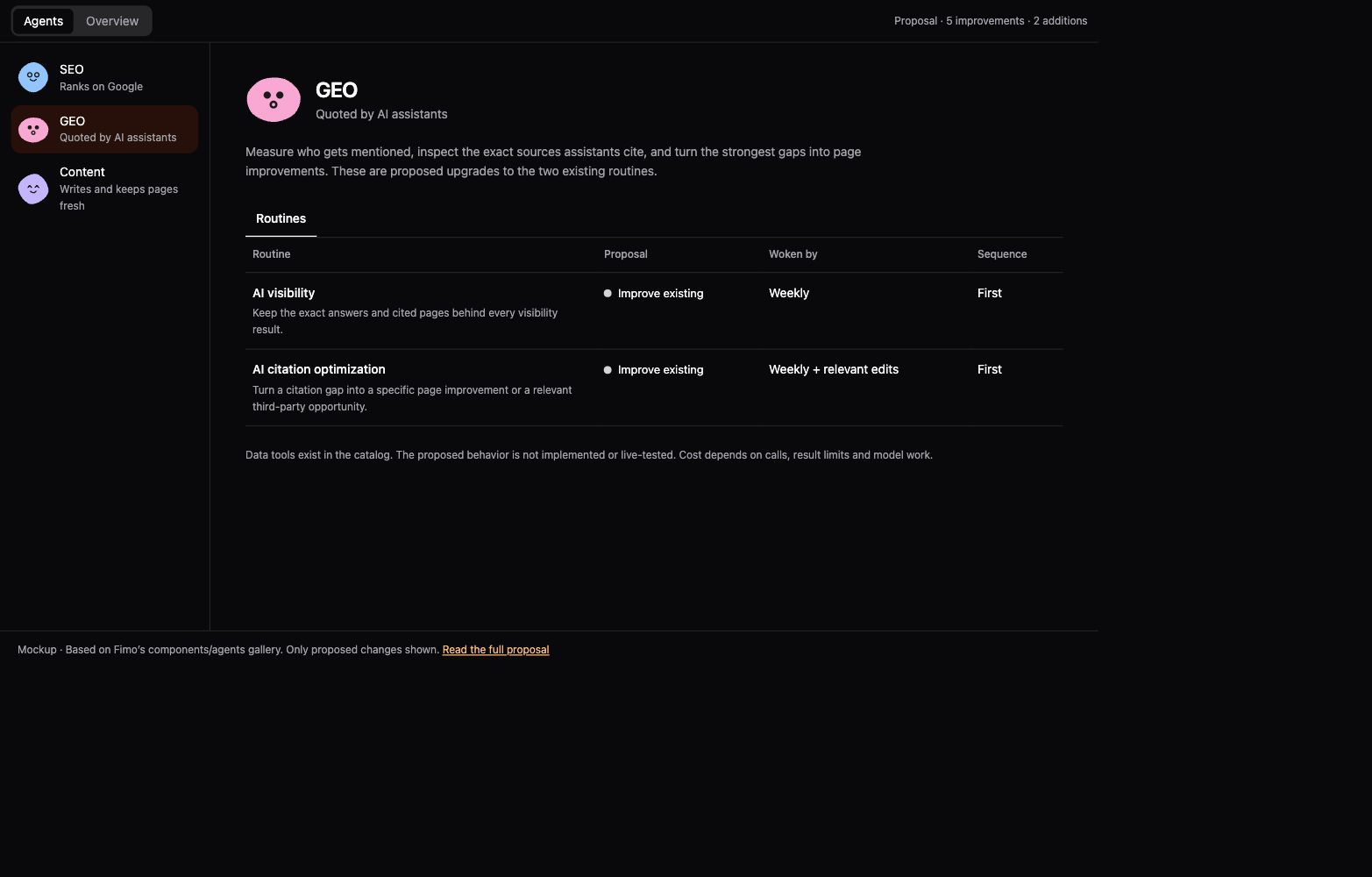
The companion gallery follows the current components/agents layout: agents on the left, routines in a table, and a run explained as Starts when → Reads → Then → Acts and asks. The statuses below describe proposed work, not shipped availability.
Keep / improve / add
Most of the work is improving decisions, not multiplying routines
Ship the citation-to-draft path first. Keyword research and refresh already have useful inputs; improve their prioritization next. Competitor monitoring earns a separate routine because outside pages change while our own site stays still.
- First
- AI visibility + AI citation optimization + Writing + Editorial review
- Next
- Keyword research + Content refresh
- Later
- Competitor watch, once a real watch list exists
| Agent / routine | Change | What the person gets |
|---|---|---|
| GEO · AI visibility | Improve existing | Keep the exact answers and cited pages behind every visibility result. |
| GEO · AI citation optimization | Improve existing | Turn a citation gap into a specific page improvement or a relevant third-party opportunity. |
| SEO · Keyword research | Improve existing | Choose a business-relevant page to improve or create, for a named market. |
| CONTENT · Writing | Improve existing | Write from evidence the business owns, with a clear reason for the page to exist. |
| CONTENT · Editorial review | New routine | Check whether the page answers its reader’s question and earns its claims. |
| CONTENT · Content refresh | Improve existing | Explain why a page needs a change before rewriting it. |
| CONTENT · Competitor watch | New routine | Notice meaningful changes to a few competing pages and decide whether our content needs attention. |
GEO · Improve existing · First
AI visibility: keep the evidence behind the number
Today: Already checks about 20 core questions and up to 5 trials across four answer engines. It keeps brand mentions, citations to the site and other cited domains.
Proposal: Retain exact external citation URLs and the claims they support. Separate branded questions from discovery questions. Show successful answers and missing coverage separately.
Starts: Weekly
Reuse the stable question set, market and language. Tag the provider, timestamp and question version.
Uses the evidence
For every successful answer, preserve cited URLs, brand mentions and short supporting excerpts when the provider supplies them.
Produces a decision
Compare like-for-like question/provider cohorts. Group recurring cited pages and hand the strongest gaps to AI citation optimization.
- Reads
- AI answers, Search Console, Site knowledge
- Remembers
- Routine data file for compact, structured observations; short agent notes for changes and approved question decisions. Bound retention to existing memory limits.
- Does
- Collect evidence and update the baseline. Stay quiet when there is no material change.
- Asks
- A change to the core question set. Never turn a failed answer into an “absent” result.
- Limit
- Pilot: 5 neutral questions × 4 engines = 20 calls/run. Expand to the current full set only after checking coverage, cost and usefulness.
Acceptance: Every citation can be traced to a provider response; failed calls are excluded from the answered denominator. Re-running saved data produces the same result.
GEO · Improve existing · First
AI citation optimization: research why another page gets cited
Today: Already proposes a direct opening answer and clearer headings, and tracks changed pages against AI questions for four runs.
Proposal: Prioritize pages from observed citation gaps and actual questions. Research what cited sources provide before prescribing headings or new text.
Starts: Weekly + relevant edits
Start from saved visibility evidence; do not buy the same AI answers again.
Uses the evidence
Read at most 5 recurring cited pages. Classify them as comparison, review, community discussion, reference or competitor page.
Produces a decision
Decide whether the gap calls for better facts on an existing page, an approved new brief, a correction to brand information, or a third-party inclusion proposal. Return at most 3 decisions.
- Reads
- Saved AI answers, Cited source pages, Google results
- Remembers
- Source URL, observed claim, question IDs, proposed action and decision. Keep a rejected proposal quiet unless its evidence materially changes.
- Does
- Research and group evidence. Send an approved content brief through the existing writing path.
- Asks
- Exact proposed copy, a new page, or a third-party placement. Outreach is drafted only; the person decides whether to send.
- Limit
- Maximum 5 source reads and 3 decisions per run; buy a live SERP only if the saved evidence cannot resolve intent.
Acceptance: Every recommendation names an actual cited page and an evidenced gap. A generic “add FAQs” suggestion without supporting evidence fails.
SEO · Improve existing · Next
Keyword research: choose a page that serves the business
Today: Already researches keywords and competitors and proposes up to 5 briefs. Writing consumes briefs after approval.
Proposal: Add business priority, buying stage, market, page type, existing page match and required original evidence to each brief. Prefer a useful update when a page already owns the intent.
Starts: Monthly + market change
Confirm the target country, language, audience and priority offer from shared knowledge. Ask once if these change the decision.
Uses the evidence
Combine real site queries with keyword estimates and live results. Distinguish a category page, comparison, guide and tool.
Produces a decision
Check the existing site for the same intent. Propose no more than 3 briefs in the pilot, each with a source, business rationale and proof needed.
- Reads
- Search Console, Keyword data, Google results, Business priorities
- Remembers
- Extend the existing shared brief record. Include intent, target page, evidence references, market and approval status.
- Does
- Research, match existing pages and draft briefs. Preserve human-written and already approved briefs.
- Asks
- Which brief to pursue; any shift in target market or positioning.
- Limit
- Pilot one market and 3 briefs/month. A second language adds independent research; it is not a reason to copy every page.
Acceptance: Reviewers can explain why the brief fits the business and whether it updates or adds a page. Local research is separate from faithful translation.
CONTENT · Improve existing · First
Writing: bring facts only this business can supply
Today: Already reads an approved brief, researches Google results, uses site facts and voice, and produces a draft for review.
Proposal: Before drafting, check the brief for a useful original contribution: a documented example, customer question, method, dataset, image, comparison or expert explanation.
Starts: Approved brief
Read the approved brief and relevant approved facts. Check that each factual claim has a source and permission for public use.
Uses the evidence
If the page needs facts that are missing, ask one focused question with a suggested answer format. A small project evidence topic is enough to start.
Produces a decision
Draft the page in the site’s voice, tie claims to evidence, and pass the draft to editorial review. Keep the draft and its review together.
- Reads
- Approved brief, Approved company evidence, Google results, Site voice
- Remembers
- Shared project evidence topic: fact, source, date, scope, public-use status and owner when known. Use existing knowledge before creating new storage.
- Does
- Draft from approved material. Reuse prior answers and avoid interviewing the person again for facts already available.
- Asks
- Missing first-hand facts and approval of the final wording. External customer reviews reveal questions, not proof of our own results.
- Limit
- One approved brief at a time. Do not block a simple factual page merely because it has no original study.
Acceptance: No invented customer results or statistics. A reviewer can trace material claims and identify the useful contribution beyond paraphrasing competitors.
CONTENT · New routine · First
Editorial review: test usefulness before asking for approval
Today: Content lifecycle checks thin/duplicate pages; Compliance checks brand rules; Quality checks accessibility, mobile and speed. None is a calibrated page-value review.
Proposal: Add a narrowly scoped Content routine for usefulness, factual support and query coverage. Keep brand rules, technical checks and accessibility with their existing owners.
Starts: Draft or substantive text change
Extract the main content and identify the page type. Exclude navigation, cookie banners and footer boilerplate.
Uses the evidence
Judge the page against the brief: direct answer, supported claims, missing decision information, original contribution and avoidable padding.
Produces a decision
Return specific passages and the smallest useful revision. A weak numerical score alone never triggers a rewrite.
- Reads
- Main page content, Brief and sources, Page-type rubric
- Remembers
- Verdict keyed to page revision and rubric version, plus resolved findings. Recheck a changed passage, not the same unchanged page forever.
- Does
- Check changed content and attach evidence to the draft. Exact source-backed repairs can follow current autonomy rules.
- Asks
- Meaning-changing rewrites or unsupported claims that need business knowledge. The review can request revision; it does not publish.
- Limit
- Run after writing settles, once per relevant revision. Start with articles and comparisons. Calibrate on human-reviewed examples before expanding page types.
Acceptance: Held-out human review confirms useful findings and acceptably few false alarms. Measure unsupported claims separately; no universal 80/100 quality threshold.
CONTENT · Improve existing · Next
Content refresh: diagnose the loss before changing the page
Today: Already finds stale facts and sustained traffic decline, and proposes exact replacement words.
Proposal: Combine decline with query intent, page changes, seasonal comparisons and commercial value. Distinguish indexing, visibility, click-through and conversion problems before choosing an action.
Starts: Monthly + verified signal
Start with sufficient-volume pages and comparable periods. Use the same country, device and query scope; check year-on-year seasonality if history exists.
Uses the evidence
Read the page and results only for a short list. Route technical problems to SEO and editorial problems to Content.
Produces a decision
Propose at most 3 updates with the suspected cause, exact change and baseline. Observe after publication; keep changes and results linked.
- Reads
- Search Console, Fimo analytics, Page history, Optional conversion data
- Remembers
- Page/revision, hypothesis, approved change, actual publish date, comparison window and outcome. Revenue attribution is unknown without connected conversion data.
- Does
- Collect evidence and route a finding to its existing owner. Record that there is not enough data instead of inferring a decline.
- Asks
- Rewriting, merging or removing a page. Reuse existing decisions and recent-change waiting rules.
- Limit
- No fixed 30-day rewrite cycle. Use current monitoring patience unless a factual or technical defect needs immediate repair.
Acceptance: Each refresh has a diagnosis and a measurable outcome. Before/after movement is an observation, not proof that the rewrite caused it.
CONTENT · New routine · Later
Competitor watch: notice meaningful outside changes
Today: Competitors already discovers competing domains and rankings quarterly. Watching particular competitor pages is explicitly not built.
Proposal: Add a bounded watch of exact pages selected from a real brief or citation gap. Do not monitor every page on every competing domain.
Starts: Monthly
Choose up to 10 public pages that matter to approved briefs, comparisons or recurring citation gaps.
Uses the evidence
Compare normalized main content against the saved snapshot. Ignore banners, dates and cosmetic churn.
Produces a decision
For a verified product or positioning change, propose an update to the affected comparison or brief. No relevant change means no message.
- Reads
- Approved watch list, Public competitor pages, Our comparison pages
- Remembers
- Bounded page snapshots in data files; short notes for why a page is watched and which change was already handled.
- Does
- Fetch, compare, deduplicate and record factual changes with dated URLs.
- Asks
- Changes to our positioning, comparisons or new content priorities.
- Limit
- Pilot 10 pages/month, not a daily whole-domain crawl. If a page cannot be read, mark the observation unavailable.
Acceptance: The second unchanged run is quiet. Every alert points to a substantive dated change and one affected page or decision.
One concrete journey
A citation gap becomes a reviewed comparison page
Illustrative scenario: a small software business wants to win a specific buying question. The example shows the handoffs and decisions; it is not a claim about Fimo’s own rankings or a real customer’s results.
GEO notices the same gap
Four engines answer five neutral buying questions. A recurring comparison source cites competitors. Two engine responses fail; the report records missing coverage instead of counting two losses.
GEO reads the cited comparison
The source explains setup effort, collaboration limits and pricing tradeoffs. The company’s current comparison page omits setup effort. GEO proposes improving that existing page.
The person approves the brief
Content asks one question: “Do we have a real setup example we can describe publicly?” The person supplies an approved example. Its scope and date stay beside the fact.
Content writes; Editorial review checks
The draft explains the example without generalizing it into an unsupported universal claim. Review catches an unsubstantiated “fastest” sentence and asks for a specific revision.
The team reviews and publishes
The draft follows Fimo’s existing Branch and review flow. Store the actual publication date; a drafted or merged change is not evidence that visitors can see it.
GEO observes the same questions again
Compare like-for-like successful answers over four runs. Report citations, mentions and coverage. Keep GSC traffic and connected conversion outcomes separate. A lift is evidence to investigate, not a causal guarantee.
External data
Use the existing data tools before adding integrations
The current catalog already exposes AI answers, search results, keyword datasets, backlinks and review sources. Catalog presence is source evidence, not proof that an operation returns every field a routine needs. Verify response shape, market support, exact citation URLs and real usage in a small live pilot.
Research tools discover and describe an operation before calling it. The paid call is metered and has a credit ceiling; this does not by itself establish a total monthly routine budget. Reuse observations between routines and keep paid work bounded.
- First-party
- Search Console, site analytics, approved facts, CMS and page history.
- External observations
- Current results, citations, public competitor pages and reviews.
- Business outcome
- Leads, signups or revenue only when a reliable source and attribution definition exist.
| Need | Current route | How to use it |
|---|---|---|
| Actual search performance | Connected Search Console | Prefer first-party query/page data. Missing connection means unknown, not zero traffic. |
| AI answers and exact sources | DataForSEO answer operations; Perplexity through the existing gateway route | Test exact URLs and answer provenance. Sampling varies by engine, market and time. |
| Keyword ideas and rankings | DataForSEO Labs + Google organic results | Estimates prioritize research; the live results establish intent and page type. |
| Questions in customers’ words | G2 / Trustpilot / Reddit operations exist | Optional research on a defined question. Public reviews do not establish facts about our business. |
| Authority / earned mentions | Ahrefs, DataForSEO and Semrush backlinks operations exist | Later, only when links or a cited third-party page are the actual gap. No automatic outreach. |
| Original proof | Existing project knowledge + approved CMS/assets | Start with a small structured evidence topic. No new evidence database required for the pilot. |
Bounded pilot
Budget calls and decisions before promising a monthly price
The current gallery contains approximate data prices, but the full run also includes reading, judging and writing. A new proposal should show measured credits and time from its own pilot. Do not reuse a vendor’s “few dollars” headline as Fimo’s price.
The pilot below is deliberately small. Paid outside research runs on a schedule because the outside world changes. Editorial work follows a changed draft; an unchanged site should not incur daily editorial checks.
- Weekly
- 5 neutral AI questions × 4 engines = 20 calls; at most 5 source reads.
- Monthly
- 3 briefs for one market; 3 refresh candidates; later, 10 watched pages.
- On demand
- One approved brief; editorial review once its draft has settled.
- Spend
- Data credits + model credits + run time + retries, per completed decision.
- Quiet site
- Editorial cost is zero with no relevant edits. Scheduled outside observations still cost.
- Scale
- The existing 25-question, 4-engine set is 100 calls/run, about 433/month at weekly cadence.
How to proceed
Deliver one complete path, then expand what it can discover
Use a representative pilot site with an approved market, one commercial content opportunity and permission to use its evidence. Each slice must end in an observable decision or draft. Update the existing templates, skills, gallery and product docs together when implementation begins.
Pin the baseline and business context
Record current answers, source coverage, draft quality, cost and run time. Reuse FIMO-2826 for the first-use market, competitor and positioning questions. Confirm which external operations return full citations.
Preserve citations and use them in one decision
Improve AI visibility storage and the existing citation routine together. Acceptance: a source-backed page recommendation, clean partial-failure handling, and a quiet second run after the decision is resolved.
Connect the approved brief to evidence and review
Extend the current brief and shared knowledge, improve Writing, then add Editorial review on the existing event/planner path. Start with two page types. Keep an explicit rubric version. Start with a proposed 40-page sample split between articles and comparisons; reserve 12 for held-out evaluation. Label useful findings, false alarms and unsupported claims. Compare current and proposed drafts on the same briefs. Set an acceptable false-alarm limit with reviewers before expanding the pilot.
Validate the whole journey with live providers
Exercise signal → brief approval → missing evidence → draft → review → person’s decision. Include unavailable data, a rejected proposal and an unchanged rerun. Product behavior, tool output and model changes need focused live-provider acceptance.
Observe outcomes, then expand
Measure useful accepted decisions, unsupported claims caught, false alarms, rewrite effort, credits and latency. Observe search/citation changes separately. Add market briefs and refresh improvements next; competitor watch only after we have pages worth watching.
Evidence and limits
Treat the reading list as hypotheses to test
The strongest research ideas are exact source inspection, useful original material and calibrated quality judgments. Avoid turning anecdotal growth results into promised outcomes. Google says its AI search features need the same SEO fundamentals, with no special AI text file or schema requirement.
Atlas structure checker: one step, no warnings. Gallery navigation, seven routine entries, dialog dismissal, and desktop/phone layouts checked. This validates the proposal artifact only.
Current agent catalog, templates, relevant skills and data-tool contracts at Fimo revision 370e5bf6f8. This confirms code structure, not production availability for every account.
Seven proposed changes and their limits. No agent prompt, routine, provider configuration or customer site was changed.
No paid research or product E2E was run for this proposal. Citation preservation, calibration, conversion attribution and full run costs need pilot evidence.
| Reference | What it contributes |
|---|---|
| SEO.party · AI visibility audit | Exact cited-source research, coverage accounting and prioritized actions. Method inspiration, not a drop-in implementation. |
| Sam Underwood · judging page quality | Main-content extraction and page-type rubrics checked against human judgment. |
| Hamel Husain · judging thresholds | Calibrate judgments with human labels; raw model scores are not probabilities. |
| Pierre Vengeons · division of work | Use data for observations, code for counting, judgment for quality and writing for expression. |
| Nicholas Dulait · commercial content | Existing-page improvements and market-specific research as hypotheses worth testing. |
| Google · AI features and your website | No additional technical eligibility requirement or special AI file for Google AI features. No guarantee of crawling, indexing or citation. |
Source map: the agent catalog, routine templates, GEO guidance and data tools are pinned to the inspected revision. Repository links may require access.